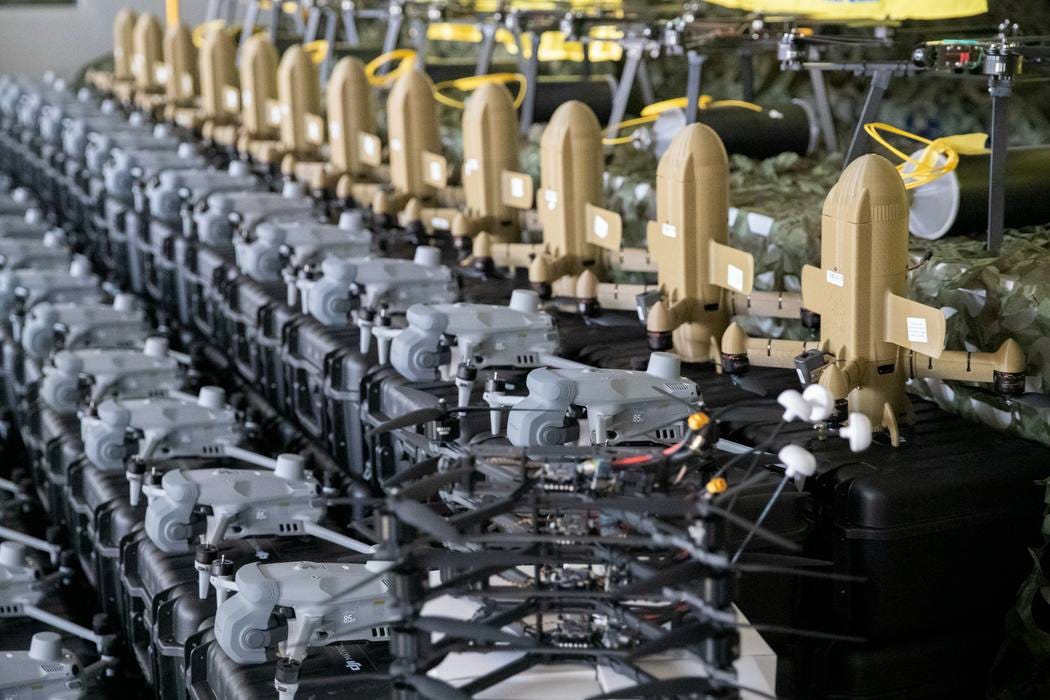
The CEO of Rheinmetall committed no sin by pointing out that Ukraine uses distributed manufacturing to produce its drones. Ukraine produces 80,000 drones a week. Can Rheinmetall and all of its competitors in Europe produce 80,000 of anything in a week? No. They can't. Read more here.
The sin Armin Papperger committed was dismissing Ukraine's distributed manufacturing as a bug rather than a feature. In fact, Papperger seems to make the mistake that many make about tech and innovation coming from Ukraine. The uninitiated think it's the drone. The drone must be the headline, the "secret sauce" coming out of Ukraine. To those of us who study and research Ukraine, we know this is not the case.
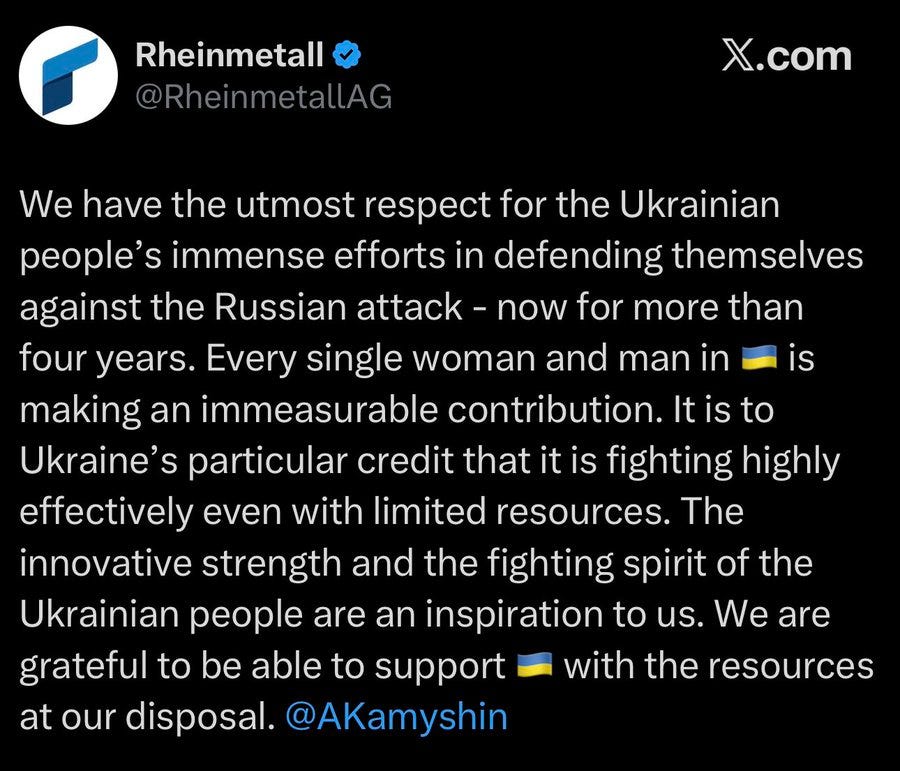
That gap is not about drones. It is about systems.
Western defense primes were built for a procurement environment that rewarded precision and tolerated delay. Contracts were structured to absorb time and cost overruns, friction. The defense prime system is optimized for peace time and COIN operations where air dominance was established quickly. We are no longer fighting Counter Insurgency. (It’s important to note that “insurgencies” are learning from the war in Ukraine and Russia. Soon even old COIN paradigms will be useless.)

The current battlespace rejects that model. Time is now treated as a failure condition. Taking too much time basically produces an error code in modern combat infrastructure. Systems that cannot iterate quickly are bypassed. Systems that cannot adapt are ejected.

Ukraine operates on a different logic. Most iteration cycles are measured in days and weeks. Design, deployment, failure, and redesign happen close to the front. Authority sits with builders and engineers. Feedback is near immediate.
Readers searching for high-quality information - such as yourself - might prefer to support my work with a one time contribution vs a subscription. https://buymeacoffee.com/researchukraine
This is where the misunderstanding begins. The uninitiated focus on the drone. They treat it as the innovation. It is visible. It is easy to describe. It is also the least important part of what Ukraine has built.
The value is in the surrounding systems.
Feedback systems that capture real-world performance and push it back into design.
Data collection systems that operate under contested conditions.
Data management systems that structure that information into usable inputs.
Manufacturing systems that distribute production and reduce single points of failure.
Supply chain systems that adapt under pressure.
These systems are the mechanism of advantage. The drone is only the expression.
Any platform trained on synthetic data or range conditions alone will fail quickly in a modern conflict. Ukraine’s dataset is built from continuous exposure to a peer adversary. That data is now foundational to Western military relevance. Only one nation possesses this in a form that is battle ready, and it’s not Germany.

What we are seeing from Armin Papperger is not ignorance. It’s actually fear. Images this week of Zelensky signing deals with the Gulf states signify money out of the hands of Western defense primes. Ukraine will do “it” cheaper, more effectively, and innovate faster to meet Gulf-specific needs. Faster than the primes can even send someone to the Gulf to evaluate the situation, then report back to Berlin and Washington to take the political temperature.
The defense primes are scared of Ukraine. Just like Merkel, Sarkozy, and Berlusconi were scared of Ukraine in 2014, the primes are scared of what a motivated, effective, and resource-rich country with the data and experience the primes will never have will do. Well, we are seeing what Ukraine will do. It will make itself indispensable.

This is where the reaction becomes revealing. Dismissing Ukraine protects the old model. Engaging Ukraine threatens it.
A non-defensive response would look different. It would acknowledge dependence on Ukrainian data. It would integrate Ukrainian testing environments into development cycles. It would treat Ukrainian systems as baseline, not edge cases. It would recognize Ukraine as an opportunity for partnership, not resource extraction.
Companies already positioned for this shift understand the stakes. Systems that are not validated in Ukraine are at a disadvantage. Systems without rapid feedback loops will lag behind.
There is also a cultural layer that should not be ignored. Some of the language used to describe Ukraine carries remnants of older Soviet and early Post-Soviet European hierarchies. A view of Ukraine as subordinate, as peripheral, as a contributor rather than a driver. If that mindset is still present, it is strategically dangerous.
Ukraine is not asking for recognition as a favor. It has already established itself as a central node in modern warfare development. The data exists. The systems exist. The results are visible.
Ukraine has a great deal to teach. It is willing to do so. The prerequisite is simple. Acknowledge where capability now resides, and adjust accordingly.
Benjamin Cook continues to travel to, often lives in, and works in Ukraine, a connection spanning more than 15 years. He holds an MA in International Security and Conflict Studies from Dublin City University and has consulted with journalists and intelligence professionals on AI in drones, U.S. military technology, and open-source intelligence (OSINT) related to the war in Ukraine. He is co-founder of the nonprofit UAO, working in southern Ukraine. You can find Mr. Cook between Odesa, Ukraine; Charleston, South Carolina.
Hate Subscriptions? Me too! You can support me with a one time contribution to my research at Buy Me a Coffee. https://buymeacoffee.com/researchukraine